

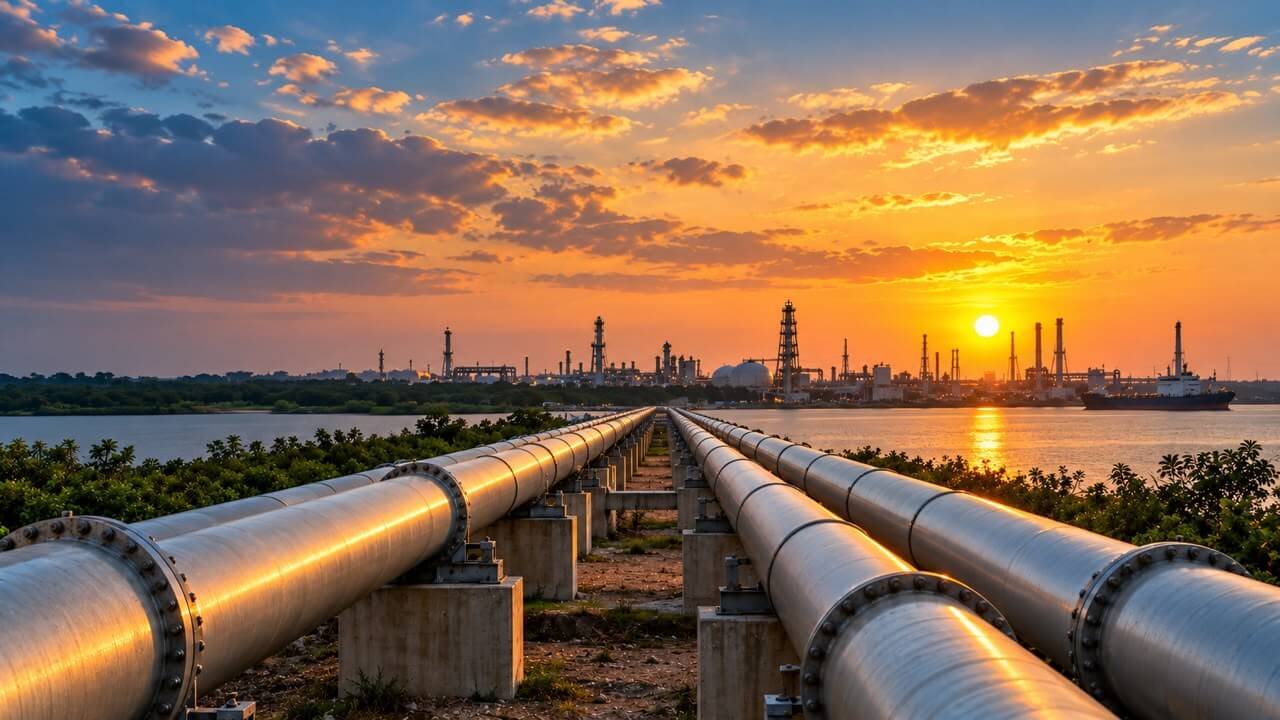
THE DECADE OF GAS MEETS THE DELIVERY TEST
With OB3 at 98% and AKK advancing, can Nigeria turn gas infrastructure into industrial capacity?
Three editions ago, LCW examined Nigeria’s ambition to turn its vast gas reserves into productive economic value—powering industries, creating jobs and improving energy access.
Today, the infrastructure required to make that ambition possible is approaching a decisive threshold.
NNPC’s latest report confirms that the Obiafu–Obrikom–Oben (OB3) Gas Pipeline has reached 98% completion, with final tie-in works targeted for August 2026. At the same time, the Ajaokuta–Kaduna–Kano (AKK) Gas Pipeline has advanced to 94% completion, supporting early gas delivery to Abuja in 2026.
Gas production has also edged up to 7.841 million standard cubic feet per day, representing an increase of 0.86% from May.
These milestones matter because they may ease long-standing constraints that have restricted gas from reaching power plants, factories and households.
But infrastructure is not an outcome.
It is an enabler.
The real test is what follows: will this new transmission capacity translate into reliable electricity, industrial competitiveness, more domestic gas utilisation and stronger Nigerian participation across the gas value chain?
OB3: 98% Is Not the Finish Line
The Obiafu–Obrikom–Oben (OB3) Gas Pipeline is a strategic infrastructure link between eastern gas-producing fields and western industrial and power markets.
At 127 kilometres in length and with a design capacity of 2 billion standard cubic feet per day, the pipeline represents a significant step towards improving Nigeria’s domestic gas transmission network.
At 98% completion, the project is close to a major milestone. However, completion alone will not define its success.
The real measure of impact will be how effectively the infrastructure supports industries, power plants and other major gas consumers.
AKK: Extending the Gas Economy North
The Ajaokuta–Kaduna–Kano (AKK) Gas Pipeline is also advancing steadily, with construction progress reported at 94%.
The project is expected to strengthen gas availability across northern Nigeria, creating opportunities for industrial clusters, power generation and broader economic activity.
Together with OB3 and other ongoing gas infrastructure projects, AKK represents an important part of Nigeria’s transition towards a more interconnected domestic gas network.
What This Means
Nigeria has spent years developing the case for gas as a foundation for industrial growth.
The country is now building much of the infrastructure required to support that ambition.
The next question is whether the infrastructure will translate into productive capacity.
Pipelines create connectivity. But industrialisation depends on what flows through them—gas delivered, factories powered, businesses strengthened and jobs created.
For Local Content Watch, this remains the central question:
Can Nigeria convert infrastructure progress into sustainable industrial capacity?
The answer will not be measured only by kilometres of pipeline completed.
It will be measured by what those pipelines enable.